|
5/18/2020 Let Mind work the problem out When faced with a problem - be it illness, a relationship challenge, a financial crisis, or any other adverse circumstance - an obsessive focus on the symptoms tends to enlarge fear. Fear is the mental element of discord that confuses and leads to errors in reasoning and mistakes in action. To clear out the offending fear, an important step is to upgrade the focus to discerning God, the divine Mind of all, as caring for every condition truly requisite for our needs.  Christian Science teaches that no one can forever escape the good ideas that come to us constantly from Mind. Christian Science discoverer Mary Baker Eddy wrote, "Mortals may climb the smooth glaciers, leap the dark fissures, scale the treacherous ice, and stand on the summit of Mont Blanc; but they can never turn back what Deity knoweth, nor escape from identification with what dwelleth in the eternal Mind." (Unity of Good, Mary Baker Eddy, p. 64:15) One way of reading that is to see that the right answer to any case is present, discoverable, and ultimately inescapable - whatever the particular circumstances may be. The Bible often illustrates the quick and transformative effect of turning to the divine Mind that is God to work out the solution to problems. For example, when Paul and Silas were stripped, beaten, chained and thrown in prison, they prayed and sang hymns of praise to God, not just for themselves, but for everyone in the prison to hear. (See Acts 16:22-36) An earthquake struck that night, and suddenly everyone was unbound and free. Interestingly though, no one left the prison lest the sleeping guard get in trouble for allowing everyone to escape. The guard became a Christian on the spot because of such unselfed love. And isn't it true that sometimes the footsteps we take out of a difficulty provides opportunities for others to learn and grow? Peter's prison experience in Acts 12, illustrates that no matter how cornered we may be by what feel like unjust circumstances, the intelligent angels of Mind are right here, guiding every progressive step. In this case, too, prayer and praise played a significant part. The church gathered to pray without ceasing for Peter's liberation. Then in the night, an angel woke him and removed his chains. The angel guided him step by step - first to dress, then to put on his shoes, then to remember his coat (see the detail of the care?), then to go down the hall past one ward, then to proceed forward through another ward - eventually leading him to the exit which "opened of its own accord." Peter was free.  Christian Science teaches that angels take many forms in our lives, but they are always Mind's inspired thoughts coming to our aide as intuitions, good ideas, that guide us forward removing whatever would restrict and providing whatever we most need. Peter just had to keep obeying the Mind's angel as it guided him safely out of trouble.
Both cases show the importance of watching and waking to the solution. Mind sends us each exactly what we need for every moment. We can trust that. We can PROVE that. Whatever the circumstance, Mind's perfect solution is ours, and we will discover it by yielding full attention to the everpresence and care of God, our divine Mind. Sponsored by Christian Science Society, Devon, UK. Lively QA session at the end!
Sponsored by First Church of Christ, Scientist, Decatur, AL. Available online until July 2, 2020.
Tomorrow is the debut of a new full length web lecture. I am very eager to share and answer your questions!
Please share and register for Finding Your Immunity from Disease on Apr 2, 2020 12:00 PM CDT at: https://register.gotowebinar.com/register/4395724748305570316 After registering, you will receive a confirmation email containing information about joining the webinar. Register at cschurchurbana.com for tomorrow's web lecture. Bring your questions, and let's think and pray together. Everyone welcome to join from wherever you are. 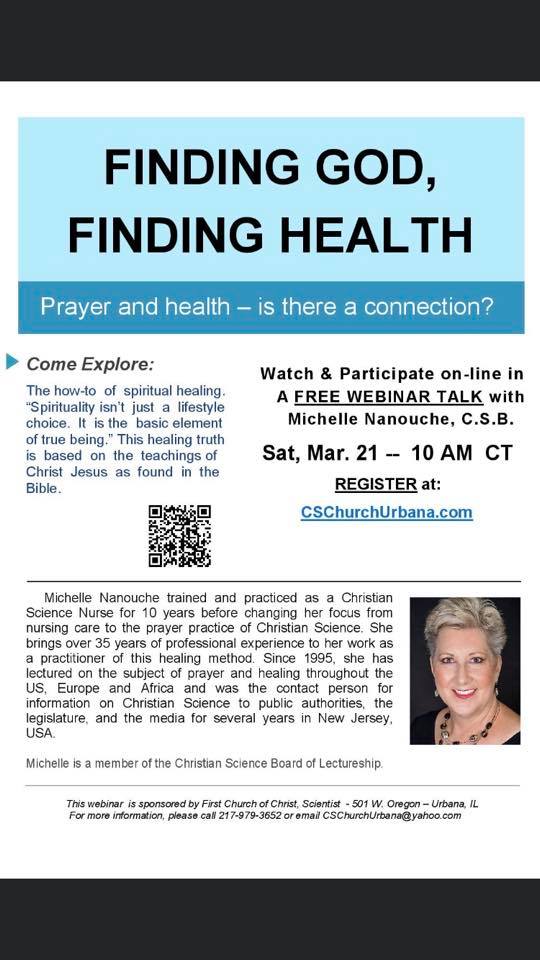 I know someone who used to schedule his sick days in advance because he expected to catch some type of illness every year about the same time. Then he learned about Christian Science, and his experience completely changed. He soon noticed that he didn’t need to take sick days with regularity anymore. And on the rare occasions that he did fall ill, he returned to work in good shape much more quickly than in the past. What made the difference? Christian Science brings out what Jesus taught of the intersection between one’s relation to the Divine and practical daily experience, bringing health and healing. Jesus’ understanding of the nature of God and God’s children as good and pure empowered him to not only safely come into contact with those suffering from highly contagious conditions, but actually heal them. And he taught that each of us could follow in the path he pointed out, too. Mary Baker Eddy, the discoverer of Christian Science and a consecrated follower of Jesus’ teachings, explained that contagion is fundamentally mental in nature rather than physical, and is engendered by fear. “Many a hopeless case of disease,” she wrote, “is induced by a single post mortem examination, – not from infection nor from contact with material virus, but from the fear of the disease and from the image brought before the mind; it is a mental state, which is afterwards outlined on the body” (“Science and Health with Key to the Scriptures,” p. 196). This is key. Prayer that leads to a better understanding of the divine Love that governs us brings out the tangible expression of that Love in daily experience. Mrs. Eddy illustrated this, healing highly contagious cases of diphtheria, tuberculosis, and membranous croup, and experiencing complete immunity in her contacts with these cases. A number of years ago while working in a care home, I contracted a contagious skin condition that had rapidly spread among the patients and caregivers. We, along with most other care homes across the region, were required by the public health authority to quarantine those affected and follow a strict regimen of medical treatment. I requested and received permission to forgo the medication in order to practice Christian Science prayer for healing, with my agreement that I would remain quarantined until the healing was complete. My prayer didn’t ask God to come heal the condition. Rather, in prayer, I sought to deepen my understanding of what it meant that God is Love and is “of purer eyes than to behold evil” (Habakkuk 1:13). Mrs. Eddy wrote, “Christian Science erases from the minds of invalids their mistaken belief that they live in or because of matter, or that a so-called material organism controls the health or existence of mankind, and induces rest in God, divine Love, as caring for all the conditions requisite for the well-being of man” (“Rudimental Divine Science,” p. 12). My prayers affirmed that God is the ever-present divine Principle, Love, and that God’s creation, including each of us, is made in God’s spiritual likeness, fully reflecting His attributes. This includes health and immunity from evil in any form, which is utterly devoid of legitimate power in the face of God’s supremacy. These ideas helped me to realize that health is not controlled by a material organism, and to trust in Love’s care for me and for all. I found that letting perfect Love, or God, into our hearts truly does lift fear (see I John 4:18). Following a brief period of prayer lasting but one day, I was healed quickly and permanently. I was authorized to return to work and care for others with the same condition, and I did so with complete immunity. And within a shorter than expected time, everyone in the home was also free of the condition. Each of us can turn to the Divine and experience the healing power of divine Love. Prayer that brings to the fore of thought God’s true nature as the source and maintainer of good, and our true nature as reflecting or including all the elements of divine good, destroys fear. And it brings to light the healing and protecting power of divine Love, and the good that flows ceaselessly from God to us. Published March 12, 2020 in the Christian Science Monitor.
3/12/2020 Finding God, Finding HealthFINDING GOD, FINDING HEALTHby Practitioner and Teacher of Christian Science healing,
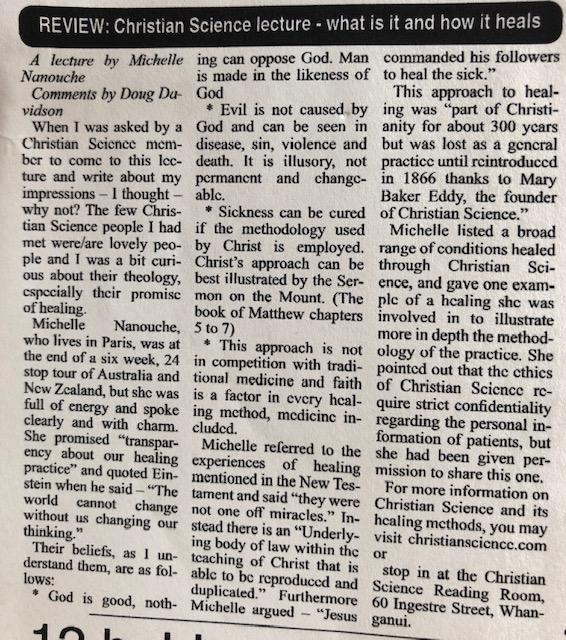
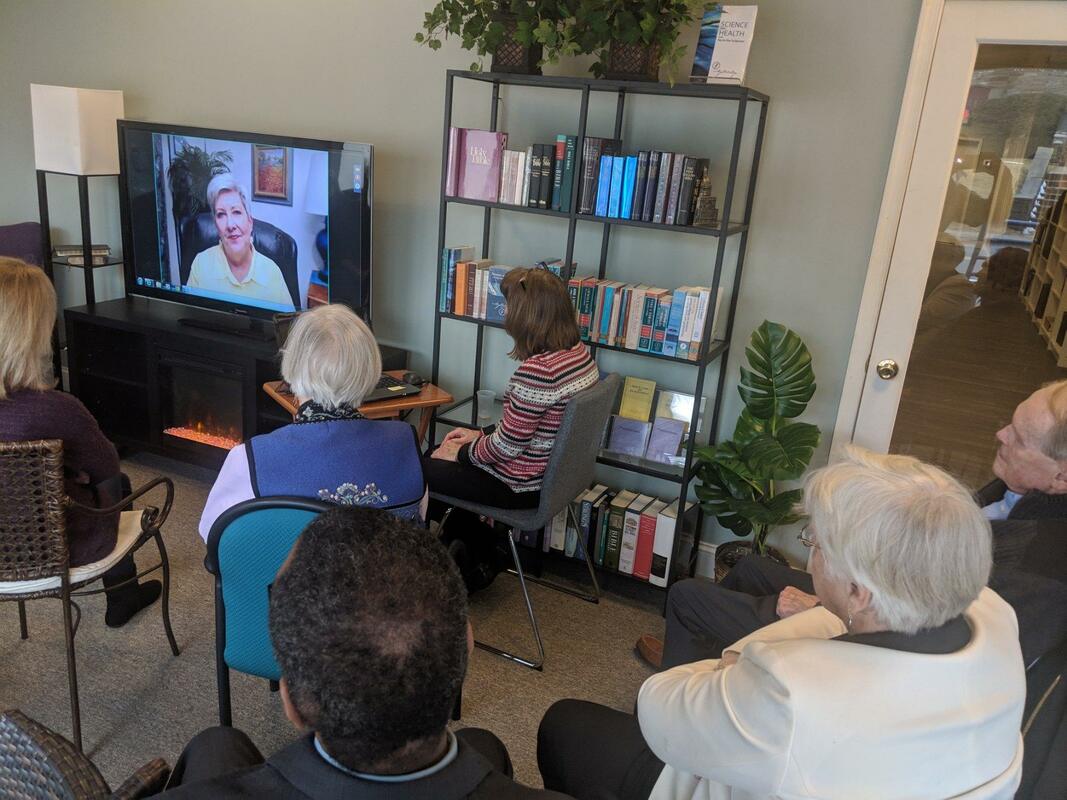
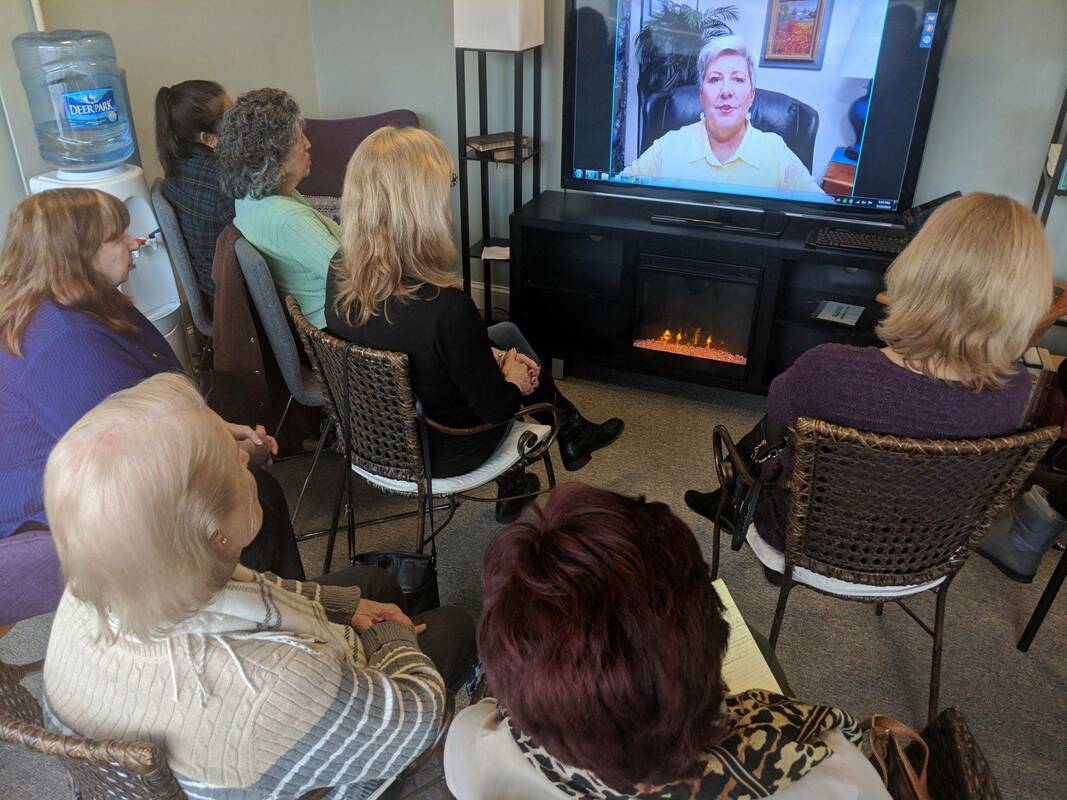
and Member of the Christian Science Board of Lectureship Michelle Nanouche, CSB Tue, Feb 11, 2020 Noon ET, 6:00 PM - 7:00 PM CET Show in Your Time Zone Christian Science Society, Canton, OH invites you to my live interactive Web Lecture. To register: https://register.gotowebinar.com/register/7673387599653618690 You may participate on your own computer or join those gathering at: Stark County Library McKinley Room 715 Market Ave N. Canton, OH, 44702 USA
As a young woman and a Christian Scientist, I intuitively knew that mine would be a life of service to others based on an unselfed love. So when the time came to consider marriage, I prayed for wisdom from God to help me know whether it would be a blessing to my work. When I got the green light and married, this symbolized my commitment to God to be “all in”—that is, to give my best thought, prayer, and action to making the marriage a success.
When my husband and I jointly decided that I should take on a demanding work project, neither of us realized the huge shift in family responsibilities that would fall to my husband. The pressure on us reached a near exploding point, and I was told to pull out of the project “or else.” I took this as a call to pray. As I did, I understood that God, as the creator of all, brings together His children in families to bless and support each other. I felt certain that if my husband felt so strongly that I must pull out, that I would. As I was going to tell him of my decision, he came to tell me that his ultimatum was unfounded, and that we could be able to see the project through as a family. And we did. When a marriage grows out of shared values and commitment to the happiness and welfare of one’s spouse, the union can provide a healthy, stable framework for progress. And Spirit, God, the source of all the spiritual qualities of good in man, is ever with us, providing the wisdom and the opportunities to surmount difficulties—and fulfill our higher purpose. As we move from an active summer into a busy fall, I am finally catching up on a couple of months of missed blog posts. Here is a modified version of the lecture recently given to an enthusiastic full house under the sponsorship of Eleventh Church of Christ, Scientist, in London. While the lecture was not recorded live, this audio recording made for radio broadcast throughout Australia last spring covers the main themes of the lecture. For those who have felt victimized by their circumstances, trailed by a sad past, or who are marked by abuse, this lecture offers insights that neutralize perpetual reaction, pain and anger. The spiritual reasoning through prayer, taught in Christian Science, unlocks one's potential for peace, forgiveness, restoration and progress. The life of Mary Baker Eddy is discussed in the context of the spiritual insight into the true nature of God and man that led to her becoming a world-renowned American religious reformer. It addresses common questions about Christian Science and its practice:
The following is a lecture follow up interview on the BBC Radio London "InSpirit" program with Jumoke Fashola.
June 20, 2019 By Michelle Boccanfuso Nanouche You might think that after months of anticipating our family trip to the beach we would be thrilled to be there together. But no. Just a couple of days of fun in the sun had left my husband, our 8-year-old daughter, and me pretty exhausted and irritable. When I had had about enough of the situation, I announced – much to my husband’s and daughter’s dismay – that we would be going to church that evening. It was Wednesday, so there was a service at the local branch Church of Christ, Scientist. You should have seen their faces. You would have thought I was dishing out a terrible punishment as they changed from swimsuits into street clothes. And honestly, maybe I had been thinking “So there! This will straighten everyone up!” Little did I realize just how much good we were all going to get out of the visit. For both my husband and my daughter, it was their first time attending one of these Wednesday evening meetings. Each service includes passages from the Bible and the Christian Science textbook, “Science and Health with Key to the Scriptures” by Mary Baker Eddy, on a topical theme. There is also singing, time for quiet prayer, and sharing of personal testimonies of inspiration and healings stemming from the study and practice of Christian Science. I will never forget what happened to us during that service. I began to feel peaceful and relaxed. Our restless daughter quieted. The frown wrinkles on my husband’s face ironed out smoothly. After the service, our girl skipped happily to the car, and my husband said, “Thanks. I feel better.” And what followed was one of our happiest family trips ever. What had happened? I don’t suppose that the physical act of going into a church caused this shift. But taking a break to engage with God’s law of harmony certainly did produce a healing change. Science and Health gives a simple definition of Christian Science as “the natural law of harmony which overcomes discord” (p. 134). So simple and direct. The complete sentence reads, “The true Logos is demonstrably Christian Science, the natural law of harmony which overcomes discord, – not because this Science is supernatural or preternatural, nor because it is an infraction of divine law, but because it is the immutable law of God, good.” “Logos,” as a Bible concept, refers to the Word of God, which is seen in God’s law of good, of harmony, always in operation. This divine power isn’t a supernatural presence that comes and goes. It enables us to understand the pure, natural good in everyone as God’s creation – an understanding of true, spiritual identity that is present, accessible, and intrinsic to all life. Any glimpse of the fundamental truth of God’s all-goodness is an encounter with the healing Christ, the divine nature Jesus expressed, showing us what we are – the spiritual good that we are made of. Christ brings the law of harmony to bear in the minutiae of our lives. This transformative coming of the Christ is what Jesus spoke of when he said, “Ye, therefore, now, indeed, have sorrow; and again I will see you, and your heart shall rejoice, and your joy no one doth take from you” (John 16:22, Young’s Literal Translation). Yielding time and attention to the Christ, we welcome a joy that doesn’t fade in our experience; it illumines it. Science and Health explains, “Whatever inspires with wisdom, Truth, or Love – be it song, sermon, or Science – blesses the human family with crumbs of comfort from Christ’s table, feeding the hungry and giving living waters to the thirsty” (p. 234). For our family that night, much-needed spiritual refreshment – the opportunity to engage with the unalterable, ageless, healing law of God, or divine good – was found at church. Each of us, whether we’re at church or elsewhere, can let Christ lift clouds of irritation, frustration, and whatever else would hide our God-given sense of joy. This helps not just us but those around us too. And who wouldn’t want that on a family beach trip – or anywhere? The article was published on csmonitor.com. Click here to find an Audio Version.
Today's lecture in Napier was preceded by the broadcast of this 17 minute radio interview. Enjoy!
Hey Friends, This interview is an edited version (ads, music, news and weather removed) of a three hour (yes, THREE hour!) BAY-FM radio interview call-in talk show I did in Queensland, Australia. The edits reduce it to a little over one hour and fifty-two minutes. This interview was set up and sponsored by the Christian Science Society in Wynnum. The station manager was pleased with the results, because their stats showed that we held the audience's attention for the full three hours, with no drop off - something rather unusual in talk-radio.
Recorded on May 3, 2019 in Sydney, Australia. Available online until August 3, 2019.
Today's Daily Lift podcast is based on an article that appeared in the Christian Science Monitor - Powerful Protest.
 Nineteenth-century Scottish philosopher Thomas Carlyle observed, “Of all acts, is not, for a man, repentance the most divine?” The Greek word “metanoia,” often translated as “repentance” in the New Testament, suggests “a transformative change of heart” (merriam-webster.com). To me, this takes repentance out of a narrow context of simply feeling regret or guilt and implies making a fresh start from a better basis. A few years back I learned a great lesson in repentance when, in an act of stubborn will, I damaged our brand-new car. Although my husband had been certain that the car wouldn’t fit in our garage, I was quite sure I could make it fit. So I waited until he went to work and tried it – eventually bashing in the back end of the car. I felt awful. Willfulness, including impulsive action, was nothing new to me. I’d been trying for years to stop my tendency toward it. I felt so upset about this latest incident that I became ill with a high fever. I was truly ready and willing to be healed of this character fault once and for all. But how?  As a student of Christian Science, I was familiar with its basic tenets, which are laid out in “Science and Health with Key to the Scriptures” by Mary Baker Eddy. One of these tenets addresses sin head on and shows how spiritual understanding destroys both the wrongdoing and its effects. Its premise is that evil is unreal – that is, has no basis in God, who is wholly good and is All – and thus has no real power over God’s creation. It begins: “We acknowledge God’s forgiveness of sin in the destruction of sin and the spiritual understanding that casts out evil as unreal” (p. 497). “Sin” means different things to different people. My study and practice of Christian Science has led me to understand sin as any action that suggests we are separate from the source of all good, from God. And I certainly was feeling separate from good as I lay in bed with a fever fretting over what I had done! I had felt regret, guilt, and shame before, and while these feelings would eventually fade somewhat, nothing much about my willful behavior changed. This time, I prayed for a fuller repentance – for the spiritual transformation that would result in reformation. The tenet cited above doesn’t blindly exonerate sin and its effects. It concludes: “But the belief in sin is punished so long as the belief lasts.” Expunging sin involves self-examination – seeing ourselves through a spiritual lens, and on this basis challenging the belief in the morbid influence of evil in our lives. This allows us to think and live by a higher standard.  I thought about the Apostle Paul’s words, “All things work together for good to them that love God” (Romans 8:28). I reasoned that it is through my relation to God as God’s child – the spiritual expression of His powerful and active goodness – that I can be good. God is All, so there is nothing to degenerate or attack God. Therefore each of us, as divinity’s reflection, is safe, uncorrupted, free from defect, capable of expressing God’s goodness. Mrs. Eddy describes good as “the primitive Principle of man” (“Miscellaneous Writings 1883-1896,” p. 14). The real source of our goodness is God, the universal Principle of divine good. Through the power of Christ, the true idea of God, we can discover the goodness we are all capable of.
I prayed with these ideas for about two hours that night. Then I fell asleep. When I woke, the fever had broken and I was well. When my husband woke, he felt a big change, too – his anger had been replaced with calm. The car was easily repaired, and we made new parking arrangements. Best of all, I had a renewed sense of my ability – my divine right – to put a stop to the willful, impulsive behavior. And from that point on, those tendencies diminished noticeably. God’s nature as good itself establishes goodness as natural. Understanding this can bring about a change of heart that washes one clean of sin and its often painful results. This spiritual repentance comes from identifying God as the source of all good and acknowledging that this goodness is the permanent, fundamental essence of us all – and helps us to bring out the very best in ourselves and others. Published May 1, 2019 in The Christian Science Monitor. For those who have felt victimized by their circumstances, trailed by a sad past, or who are marked by abuse, this lecture offers insights that neutralize perpetual reaction, pain and anger. The spiritual reasoning through prayer, taught in Christian Science, unlocks one's potential for peace, forgiveness, restoration and progress.
The life of Mary Baker Eddy is discussed in the context of the spiritual insight into the true nature of God and man that led to her becoming a world-renowned American religious reformer. It addresses common questions about Christian Science and its practice:
The following is the full length of a radio interview conducted by Philip Gould of CSBV Productions, to air at various times and in several segments on the following stations in and around Sunshine Coast, Australia, in the weeks commencing 15th April:
Sundays 8.00 am on 94.1 FM Wednesdays 8.20 pm on 1179 AM (Vision Australia) Sundays – Tuesdays 6.00 am / 5.00 pm on 1179 AM Weekdays 6.24 am on 98.1 FM I had a rich and informative discussion with Elaine Glover on her morning broadcast last Friday March 23rd. I had just lectured for First Church of Christ, Scientist in Bournemouth the night before. Elaine's own interest in the subject of Christian Science, and her openness to learn about different faith traditions, prompted the kind of questions that would help a broad range of listeners. Enjoy and share!
Settling into my airplane seat on the next leg of a long business trip, I heard a man say to his seat companion behind me, “I am so happy we live here. I love our home. I love our neighbors.” I didn’t really want to eavesdrop, but the sincerity in his voice drew me in. Next I heard, “I am grateful for our friends and for my work here. I am grateful for you!”
This flight was a year ago, yet I still remember his words clearly. Why? Because his list of heartfelt gratitude made me feel grateful, too. I considered the good in my life and all around me, and a fatigue that had accompanied me onto the flight dropped away completely, allowing me to arrive at my next stop joyful and energetic. More than just positive thinking, gratitude can be a powerful, spiritual force for good, rendering one receptive to healing. I once found myself in desperate straits, and gratitude was key to my turnaround. I had been ill for some time and became very discouraged. The list of what was wrong seemed to grow every hour, and I was very tired of it all... Click here to read the rest of the article. Published on csmonitor.com on November 23, 2018 and in the March 4, 2019 issue of the Christian Science Sentinel.
Replay available online through June 10, 2019
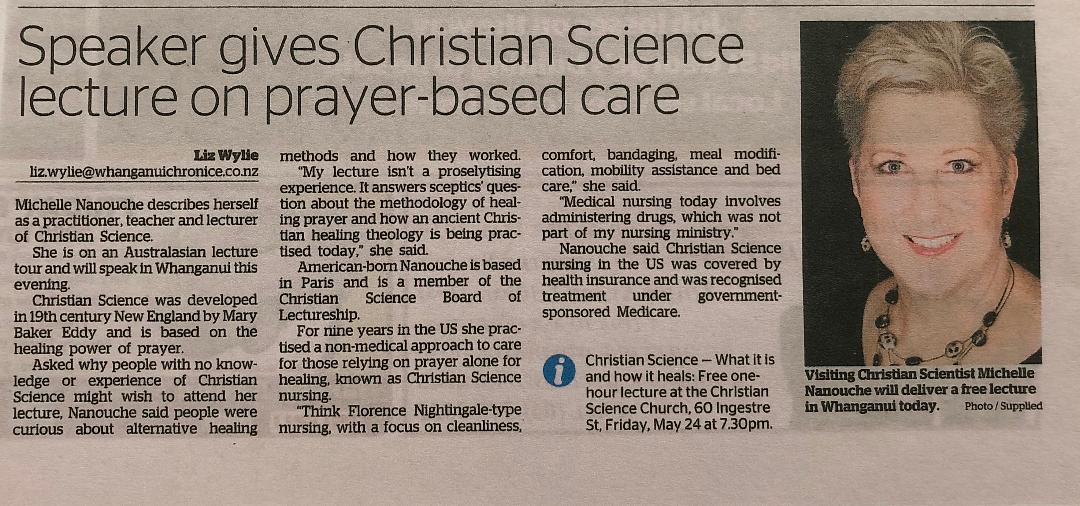
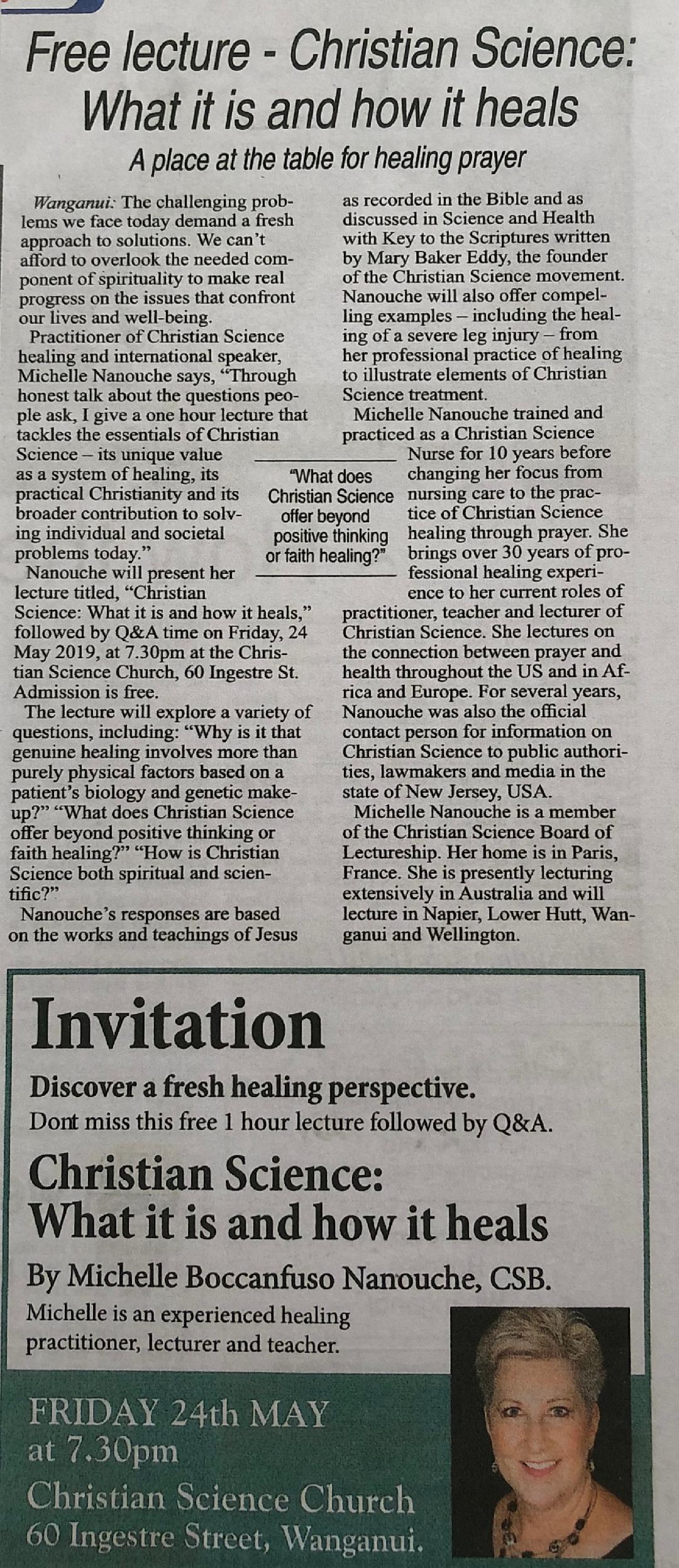
Lecture sponsored by First Church of Christ, Scientist, Jenkintown, PA.  Here is a Daily Lift based on a Christian Science perspective article that I wrote for the Christian Science Monitor: Overcoming the Monday morning blues
csmonitor.com October 12, 2018 By Michelle Boccanfuso Nanouche Recently I came across a joke online that said, “It’s Monday. I am refreshed and ready to hate my job.” This reminded me of the 1993 film “Groundhog Day,” which tells the story of a guy stuck repeating the same rotten scenario every time his alarm goes off in the morning. Perpetually waking to the same day, Feb. 2 (observed as Groundhog Day in the United States and Canada), the lead character goes with the miserable flow, trapped in a cycle: His job is a mess. His relationships are a mess. As a result he sinks into despair. But my favorite part of the film is when this lead character changes his approach. It starts with a mental shift: He decides to take each moment to master something good. Among other things, he tries to be helpful to others and to live more generously. There is progress, with occasional setbacks, but he begins to see in each day new opportunities to express more grace. I could relate to this situation. I remember when Mondays were dreaded days for me as I prepared to go to what felt like a dead-end job. I changed employers three times, but found that my experience remained miserable. I was so unhappy that my weekends were full of fear of the impending workweek. Something needed to change, and moving to another job clearly hadn’t been the answer. Trying to think more positively was certainly a possibility, but I’ve found that isn’t enough to effect a radical change and produce stable joy in one’s experience. What had helped me in numerous ways was Christian Science, discovered by Mary Baker Eddy, which has given me a different view of what really brings progress. It teaches that God, as divine Life, is the only true source, maintainer, and motivator of creation, including each one of us as God’s spiritual offspring, and it reveals that this infinite Life is solely good. Acknowledging Life as the divine Principle of good can open one’s eyes to see God’s blessings all around us, breaking us free from negative thought patterns. Even more, prayer that explores the true nature of creation as the spiritual manifestation, or expression, of Life, God, can uplift our expectations and inspire steady, graceful forward momentum in daily life. So I began devoting my early mornings before work to searching the Scriptures for insights into the nature of God as Life, to understand more of what God had in store for me. I found this study empowering and strengthening as I learned that God’s will for me (and everyone) includes a truly substantial joy. For instance, after explaining the permanent, nurturing relation of God to His creation, Christ Jesus said, “These things have I spoken unto you, that my joy might remain in you, and that your joy might be full” (John 15:11). And I began to carry a Bible verse or hymn to work in my pocket, which I could pull out during the day to remind me that God created and maintained me as joyful. Not long after I incorporated such prayer into my morning routine, I began to wake up on Mondays eager to get up, because I was looking forward to expressing more of God’s goodness during the day, including at my job. As a result, the days felt more meaningful no matter what tasks I was doing, and the recurring dread did not return. It was a transformative experience and one I will always cherish. Each of us can break out of a negative cycle in which days seem to replicate themselves as joyless, void of inspiration or the promise of progress. Divine Life provides us with daily opportunities to experience and express good. And seeking clearer views of this Life allows us to expect and experience a more abundant joy and progress. |

Find me on YouTube
I have practiced Christian Science professionally in some form since 1979. But my journey with Christian Science started in a Sunday school where as a young child I was taught the Scriptures and some simple basics of Jesus' method of scientific Christian healing. A significant experience at the age of twelve opened my eyes to the great potential of this practice. After impaling my foot on a nail, I prayed the way I had learned in Sunday school. Within moments the pain stopped and healing began. By the next morning the wound had disappeared completely. Having experienced the great potential of Christian Science, there would be no turning back. |



 RSS Feed
INFORMATION |
SERVICES |
HELP |

© 2011-2024 Michelle Boccanfuso Nanouche, CSB. All rights reserved. Pages updated February 6, 2024.